
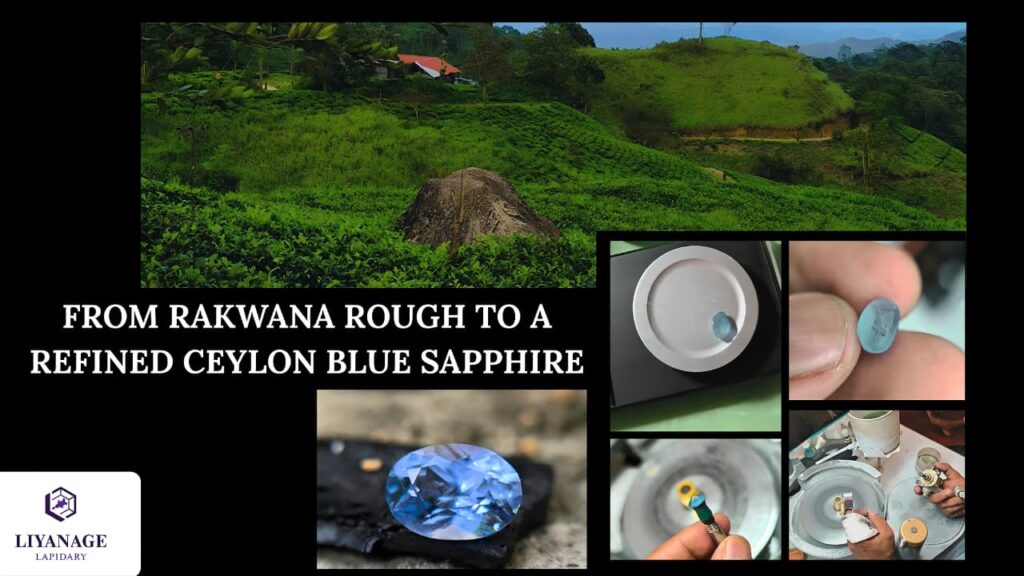
Every natural gemstone has its own internal character, and understanding that character is one of the most important parts of professional lapidary work. Some rough gemstones offer a relatively straightforward cutting process, while others require careful evaluation, selective material removal, and thoughtful cutting decisions. This natural unheated blue sapphire from Rakwana, Sri Lanka, is a good example of how careful planning can transform a rough gemstone into an attractive finished stone.
Beginning with a 3.41 ct natural blue sapphire rough, the cutting journey involved identifying an included area, removing unsuitable material, preparing the gemstone for faceting, and selecting a modified oval radiant-style pavilion. The final result was a 1.55 ct blue sapphire measuring 7.8 × 5.6 × 4.4 mm, displaying attractive blue color and excellent luster.
Rakwana – A Sri Lankan Gemstone Source
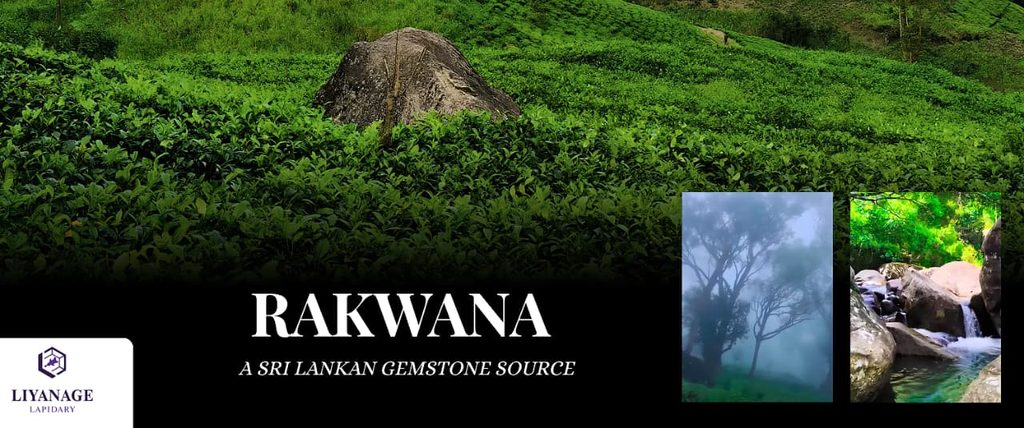
Rakwana is located in Sri Lanka’s Sabaragamuwa Province, within a region associated with the country’s longstanding gemstone trade. Surrounded by green mountains, forest landscapes, and gemstone-producing communities, the area is familiar to many people involved in Sri Lankan rough gemstone sourcing.
Sri Lanka, historically known as Ceylon, has supplied natural sapphires and other colored gemstones to international markets for generations. Areas such as Rakwana remain relevant to gemstone dealers and lapidary professionals looking for rough material with interesting colors, natural internal characteristics, and cutting potential.
For Liyanage Lapidary, understanding the relationship between gemstone sourcing and cutting is essential. The appearance of a rough stone is only the beginning. Its real cutting potential becomes clearer through careful examination, particularly when inclusions, fractures, or irregular shapes influence the finished result.
The Original 3.41 ct Blue Sapphire Rough
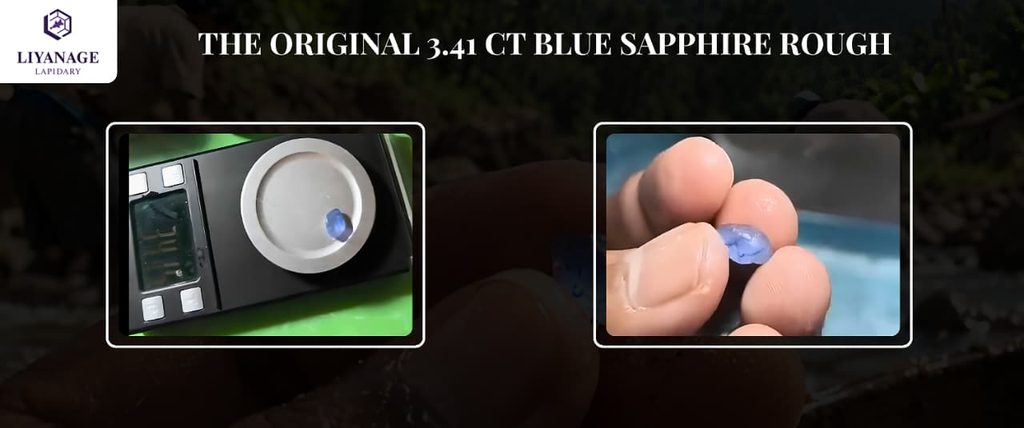
The journey began with a 3.41 ct natural unheated blue sapphire rough sourced from Rakwana, Sri Lanka. The rough displayed a blue body color, along with natural surface characteristics and internal features that needed careful inspection before cutting.
Although the rough contained an included area, it also offered material suitable for faceting. The important consideration was identifying the best usable portion of the crystal and deciding how the unwanted material could be removed without unnecessarily sacrificing the remaining gemstone.
A successful cutting decision is not based on weight alone. The orientation of the color, depth of the rough, position of inclusions, possible finished shape, and expected light return must all be considered together.
Rough Examination and Inclusion Removal
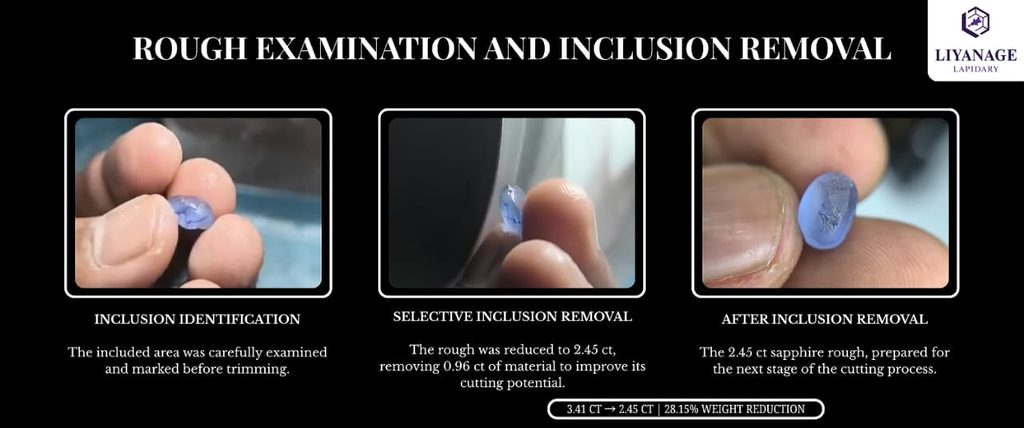
Before beginning the main cutting process, the stone was carefully examined to locate its included area. This area was identified and marked so that the cutter could plan the removal of unsuitable material.
Rather than attempting to retain the entire rough, we decided to remove the problematic portion and concentrate on the more suitable body of the stone.
Following this initial trimming and inclusion-removal stage, the gemstone weighed 2.45 ct.
This meant approximately 0.96 ct of material had been removed from the original 3.41 ct rough, representing a weight reduction of 28.15%.
The purpose of this stage was to improve the cutting potential of the remaining gemstone and create a more suitable starting form for the next steps.
Removing the main included area does not automatically mean a finished gemstone becomes completely inclusion-free. It means the cutter has addressed a particular feature that could affect the desired finished appearance or structural quality.
Pre-forming the Sapphire
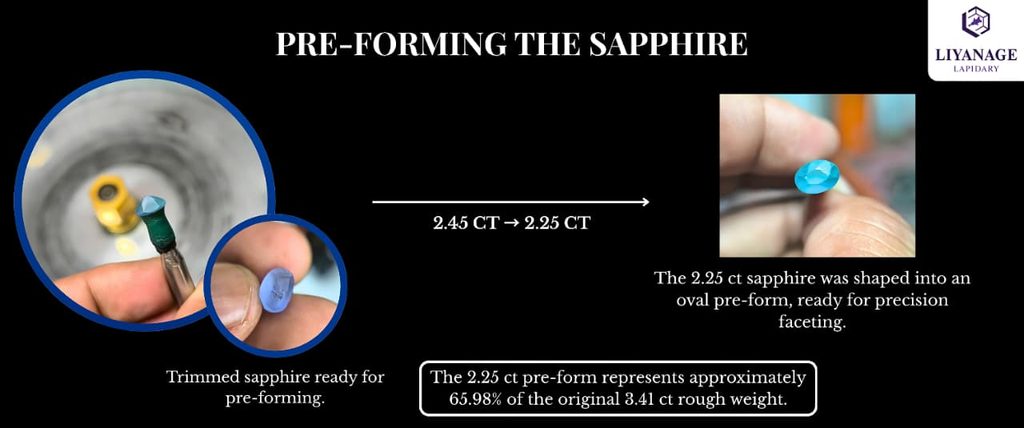
After the initial trimming, the gemstone moved into the pre-forming stage.
Pre-forming is an important step between rough examination and final precision faceting. During this process, the cutter gradually establishes the intended outline, proportions, and orientation while preparing the gemstone for more accurate facet placement.
The blue sapphire was shaped with its final oval design in mind. The remaining material was carefully worked into a form suitable for further cutting.
After basic pre-forming, the gemstone weighed 2.25 ct.
Compared with the 2.45 ct trimmed stone, this stage removed another 0.20 ct. The pre-form retained approximately 65.98% of the original rough weight.
At this point, the gemstone was ready for the main faceting process, with its shape and orientation established.
Choosing a Modified Oval Radiant Pavilion
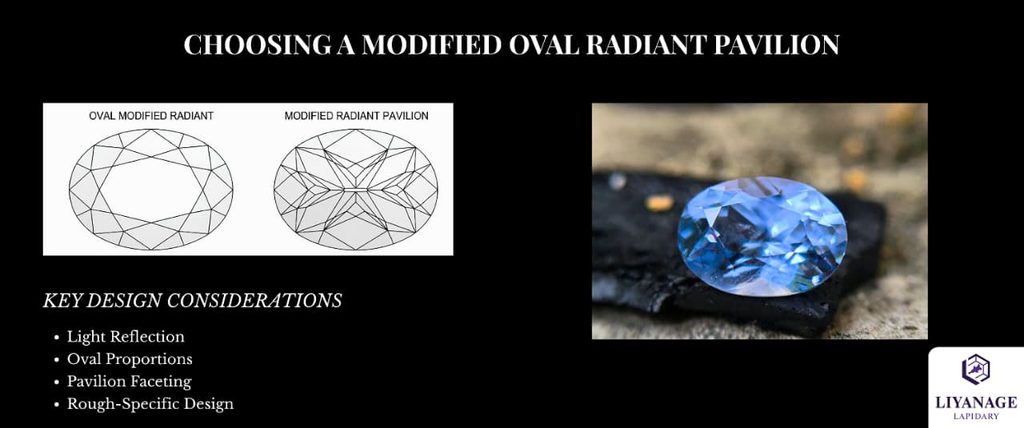
For the final cutting design, we selected a modified oval radiant-style pavilion.
This approach was chosen to develop attractive light reflections within the remaining gemstone while maintaining a practical oval outline.
Unlike a simple step-cut pavilion, a radiant-style faceting arrangement uses multiple reflective surfaces to influence how light travels through the gemstone and returns toward the viewer.
The exact visual result depends on the gemstone’s refractive properties, facet angles, symmetry, polish, and internal characteristics.
For this sapphire, the selected pavilion design helped produce an attractive finished appearance while working within the proportions available after trimming and pre-forming.
The decision reflected an important principle in gemstone cutting: the design should suit the individual rough rather than forcing every gemstone into the same cutting pattern.
Faceting and Final Polishing
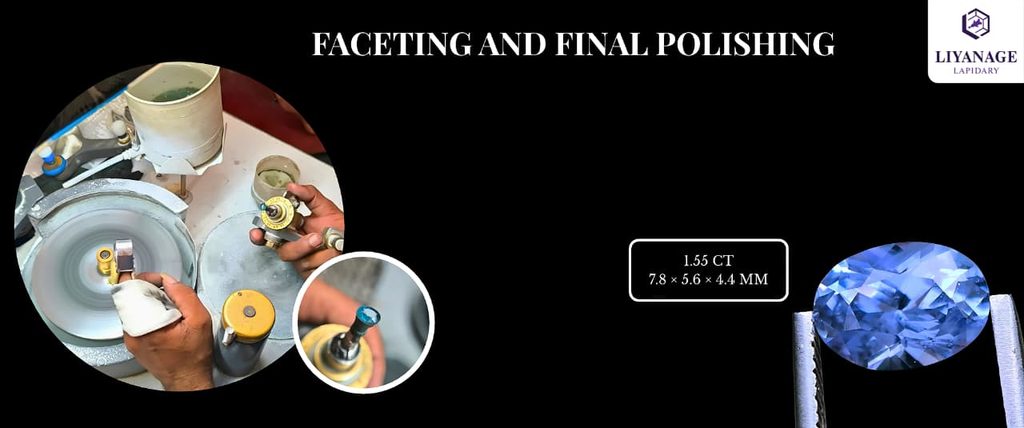
Once the basic form was prepared, the cutting process continued through careful faceting.
The cutter gradually developed the pavilion facets, established the necessary angles, and refined the gemstone’s symmetry. Each facet required controlled positioning to achieve an appropriate relationship with the surrounding surfaces.
The gemstone then passed through the polishing stages, where the facets were finished to reveal the stone’s final surface luster.
The polishing process is particularly important because even a well-planned gemstone can lose visual appeal when its facets are poorly polished or inconsistently aligned.
After completing the faceting and polishing, the finished blue sapphire weighed 1.55 ct and measured 7.8 × 5.6 × 4.4 mm.
The final stone displays attractive blue color, reflective faceting, and excellent luster.
The Cutting Recovery – From 3.41 ct to 1.55 ct
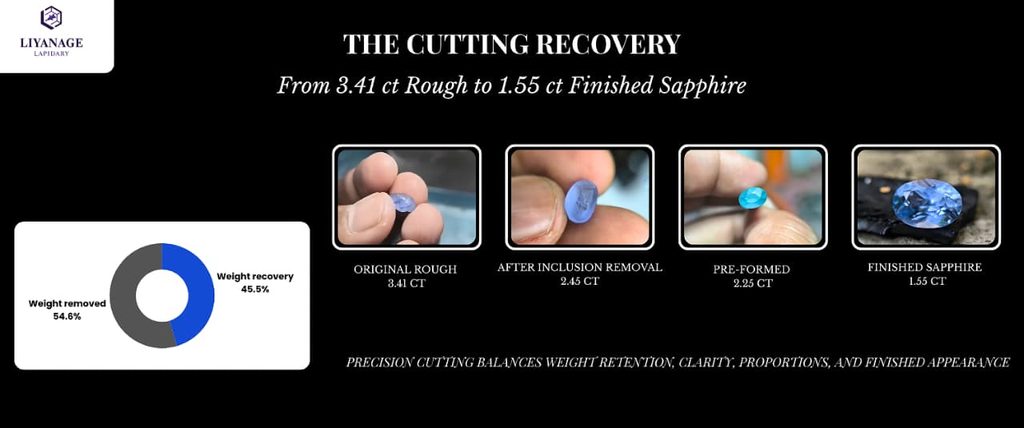
The original rough weighed 3.41 ct, and the final polished gemstone weighed 1.55 ct.
The total cutting recovery was approximately 45.45%, with a total weight reduction of 54.55%, equivalent to 1.86 ct of material removed during the complete transformation.
The cutting process can be understood through its four recorded stages.
The original 3.41 ct rough was reduced to 2.45 ct after removing the main included area and unsuitable material. Following basic pre-forming, the weight became 2.25 ct. The final faceting and polishing stages produced the finished 1.55 ct sapphire.
From the 2.25 ct pre-form to the 1.55 ct finished gemstone, the final stage retained approximately 68.89% of the pre-formed weight.
These figures demonstrate how material is gradually removed for different reasons throughout the cutting process.
A recovery percentage alone does not determine whether a gemstone has been cut successfully. The final appearance, structural integrity, proportions, color presentation, and surface finish are equally important.
For this particular stone, removing the main included area was a deliberate decision before completing the final design.
Understanding the Gemology of Blue Sapphire
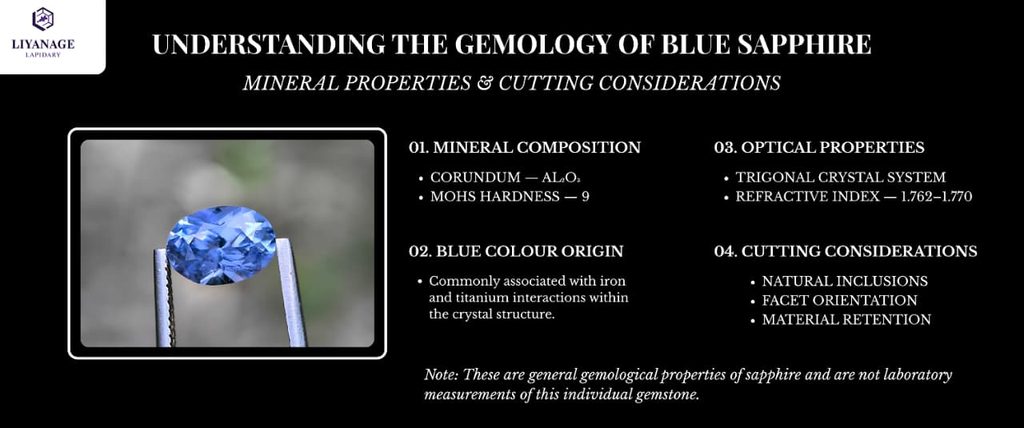
Blue sapphire belongs to the corundum mineral family, with the chemical composition Al₂O₃. Corundum has a hardness of 9 on the Mohs scale, making sapphire one of the hardest naturally occurring gem minerals used in jewelry.
Blue coloration in sapphire is commonly associated with interactions involving iron and titanium within the crystal structure.
Sapphire belongs to the trigonal crystal system and typically has a refractive index of approximately 1.762–1.770, although exact values vary.
These are general gemological properties of sapphire and should not be interpreted as laboratory measurements of this individual gemstone.
Natural inclusions and surface characteristics can influence cutting decisions, particularly when an inclusion lies close to the intended pavilion, crown, or girdle.
By studying these features before faceting, a cutter can make more informed decisions about which areas to retain and how to orient the finished gemstone.
The Final Blue Sapphire – A New Appearance
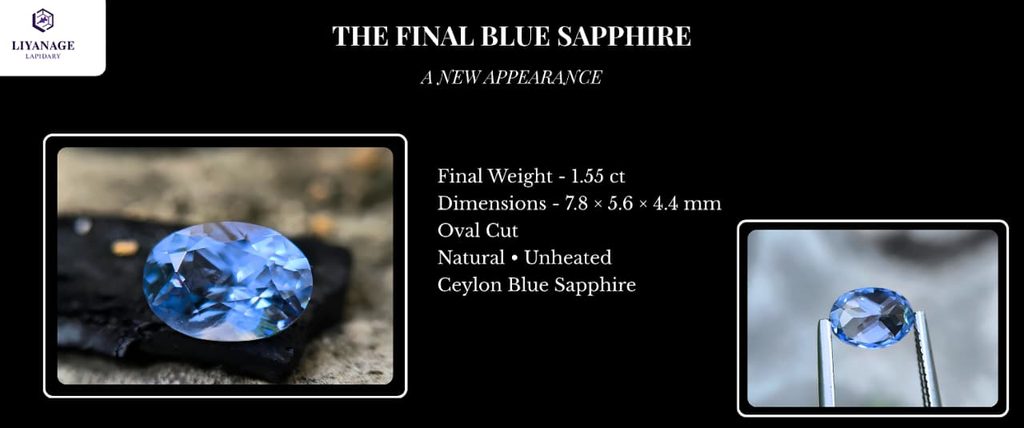
The transformation from the original rough to the finished gemstone shows how much the appearance of sapphire can change through carefully selected cutting and polishing.
The original stone contained a usable blue body alongside an included area that required removal.
After trimming, pre-forming, modified radiant-style pavilion cutting, and final polishing, it became a 1.55 ct oval blue sapphire with excellent luster.
The final dimensions of 7.8 × 5.6 × 4.4 mm provide a practical size for consideration in custom jewelry, gemstone collections, and professional dealer stock.
Its oval outline is suitable for several jewelry design approaches, including gemstone rings, pendants, and individually designed settings.
The finished gemstone remains an unheated Ceylon blue sapphire, with its natural origin connected to the Rakwana source area.
Sri Lankan Lapidary Expertise and International Gemstone Supply
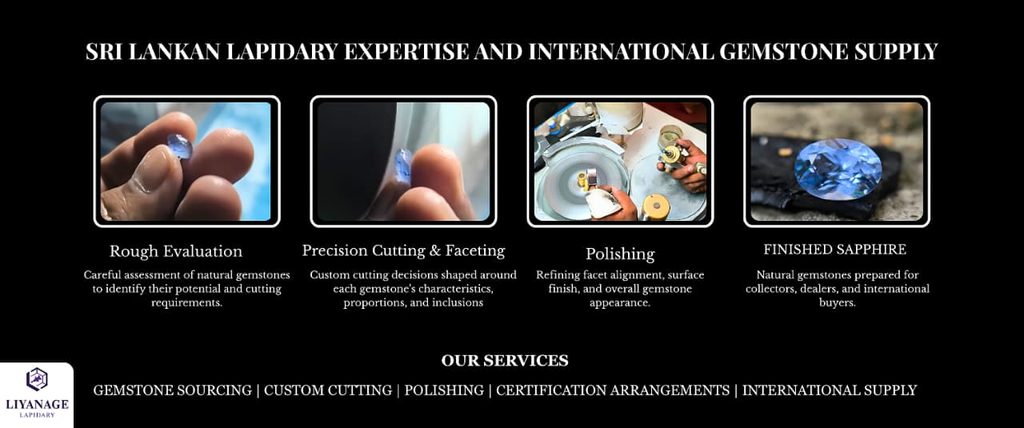
This transformation illustrates the practical work involved in professional gemstone cutting.
From the initial evaluation of the rough to inclusion removal, pre-forming, facet planning, polishing, and final examination, each stage contributes to the finished result.
Liyanage Lapidary works with natural gemstones from Sri Lanka and other international sources, supporting gemstone buyers through rough evaluation, cutting, polishing, and finished gemstone supply.
For international buyers, the ability to understand a gemstone’s source and transformation is valuable. Rough-to-finished records help explain why a particular cut was selected, how much material was retained, and how lapidary decisions influenced the final stone.
Depending on individual requirements, Liyanage Lapidary also supports discussions regarding gemstone sourcing, custom cutting, certification arrangements, and international gemstone supply.
From Rakwana Rough to Finished Ceylon Blue Sapphire
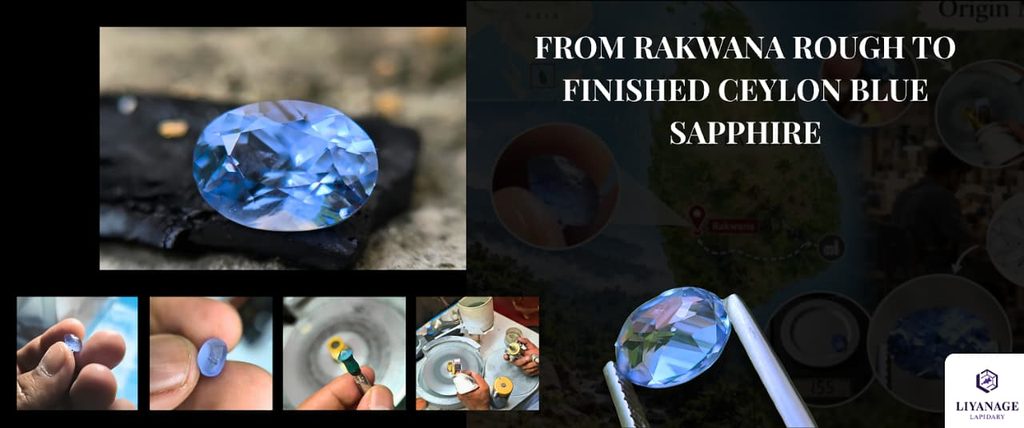
The journey of this sapphire began with a 3.41 ct natural rough gemstone from Rakwana, Sri Lanka.
After removing the main included area, the stone was reduced to 2.45 ct, then carefully pre-formed to 2.25 ct before the final faceting and polishing stages.
The completed gemstone weighs 1.55 ct and measures 7.8 × 5.6 × 4.4 mm, finished with a modified oval radiant-style pavilion and excellent luster.
With a final recovery of 45.45%, the result reflects a considered balance between removing unsuitable rough material, establishing the desired shape, and producing an attractive finished sapphire.
From the gem island Sri Lanka, this cutting journey represents the connection between natural gemstone sourcing, careful rough evaluation, and practical lapidary craftsmanship.
Liyanage Lapidary continues to support gemstone dealers, collectors, jewelers, jewelry manufacturers, and international buyers seeking natural gemstones and professional rough-to-finished cutting services.
FAQ – BLUE SAPPHIRE CUTTING JOURNEY
1. Where was this blue sapphire sourced?
The original rough was sourced from Rakwana in Sri Lanka’s Sabaragamuwa Province.
2. What was the original rough weight?
The natural unheated blue sapphire rough weighed 3.41 ct before cutting.
3. Why was some material removed before faceting?
The rough contained an included area that was identified and marked for removal. Removing this material helped prepare the remaining gemstone for cutting.
4. What was the weight after inclusion removal?
After removing the main included area and unsuitable material, the sapphire weighed 2.45 ct.
5. What was the pre-form weight?
The gemstone weighed 2.25 ct after basic pre-forming.
6. What was the final finished weight and size?
The finished blue sapphire weighs 1.55 ct and measures 7.8 × 5.6 × 4.4 mm.
7. What cutting style was selected?
The gemstone was finished with an oval outline and a modified radiant-style pavilion.
8. What was the final cutting recovery?
The total cutting recovery was approximately 45.45%, with 54.55% total material loss.
9. Is this blue sapphire heated?
The sapphire is described as unheated.
10. Is the finished sapphire suitable for jewelry?
Yes. Sapphire has a Mohs hardness of 9, and the finished oval shape can be considered for rings, pendants, and custom jewelry with appropriate setting design.